This is the second installment of the Scholarship of Teaching and Learning (SoTL) Scholars Spotlight Series, which features updates from faculty members designing, implementing, and disseminating meaningful SoTL projects.
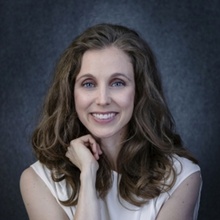
We’re excited to feature Kristin Marrs, a faculty member in the Department of Dance at the College of Liberal Arts and Sciences. Professor Marrs’s SoTL study, titled “Ballet in the Round,” explores student progress and perceptions of a reimagined ballet class where students work collaboratively in a circle rather than standing in rows at a traditional barre.
Tell us what you teach, what inspired your SoTL project, and what it focuses on.
I teach ballet, the Alexander Technique, and somatically based anatomy courses in the Department of Dance, as well as the Graduate Independent Projects and Teaching Dance in Higher Education graduate courses.
In my ballet class, I teach students how to coordinate and strengthen their “inner barres” and engage in partnered support (i.e., two or more dancers offering physical support to one another) rather than relying on barre for balance.
This class structure and SoTL project evolved from my teaching values, student feedback, and observations of student performance. Students often expressed feeling stifled or restrained in ballet compared to other forms of dance. In response and leaning into research highlighting the limitations of barre and the negative impacts of the use of mirrors, I removed both elements from my class. Though initially challenging, this shift has led to more freedom, ease, and a better understanding of upper and lower body coordination among my students that translates across multiple dance forms. I have also learned some great lessons along the way about how to better scaffold the learning processes, so students could move more confidently away from the barre. My current iteration of the class incorporates the barre early in the semester and gradually prepares students to work without it.
What do you enjoy most about teaching or mentoring students?
I love ballet, and I also find so many aspects of what we might call “ballet culture” to be harmful. I am really on a mission to separate the joy of moving and learning this technique from some of the damaging historical pedagogical practices and norms. I want students to understand they are not inherent to the genre and that there is no such thing as a single “ballet body.” Any “body” doing ballet is a ballet body. Helping my students experience this is one of the most satisfying elements of my teaching. I also enjoy mentoring students to help them uncover their skills and passions, rather than imposing mine on them. I have had the humbling experience of helping launch students on their own trajectories in many fields, whether related to dance or not.
How has your disciplinary expertise shaped your approach and process of conducting your SoTL study?
My background in experiential anatomy and the Alexander Technique—a mind-body practice popular among performing artists— informs my teaching and my SoTL study. My experience in these areas helped me see the unique potential of each student and identify any gaps between what I was saying (i.e., move with your whole body and mind) and what I was doing (i.e., try moving with your whole body while clutching a barre for half the class). I don’t think I would have embarked on this SoTL study if I didn’t have such a deep appreciation for the beauty of anatomical variety and individuality of each student.
How has the Center for Teaching helped you move your SoTL project forward?
This study wouldn’t have happened without the Center for Teaching. The Institutional Review Board process is so complex for those not versed in social sciences, and I am so grateful for their help in navigating that essential part of studying my teaching. They have been so collaborative, and the additional funding available to SoTL scholars through the P3-funded program will further support my project through the recruitment of research assistants and/or conference registration and travel fees. I am looking forward to presenting my research to both dance and SoTL communities, and I’m getting closer to publishing it.
How do you envision your project contributing to teaching and learning at the University of Iowa or more broadly?
While my study may seem dance-specific, I hope it can inspire teachers to consider how structural, spatial, or temporal elements of their classes may help or hinder their teaching and their students’ learning. Many of these elements of education are taken for granted or considered the norm. We can challenge ourselves to reconsider different elements, like how the desks are arranged, how we indicate who gets to speak, how we place value on different kinds of participation, and the balance of individual and group work.
What advice do you have for faculty who are curious about some aspects of their teaching but are not yet familiar with SoTL?
Meet with someone from the Center for Teaching! They are incredible thought partners. Also, joining one of the SoTL community groups is a great way to hear what folks from other disciplines are doing with their teaching and learning.
As a director of graduate studies, what advice would you give to other directors of undergraduate studies who want to cultivate a departmental culture that values and supports SoTL work among their faculty?
I am lucky to be in a teaching-centered department. Even among our research faculty in dance, there is a strong culture of commitment to teaching excellence and growth. At the same time, it is easy to get siloed in one’s teaching practices. I encourage leadership at every level to spread the word about SoTL as a means of fostering pedagogical research and opening conversations among faculty about their teaching successes and challenges. I also encourage graduate students interested in pedagogy to learn about SoTL and its potential to help them grow as teachers and scholars.
Interested in pursuing your teaching and learning curiosities and turning them into a SoTL study? The Center for Teaching can support you as you develop your SoTL ideas, research questions, project design, or methods. To learn more or schedule an individual SoTL consultation, contact us at teaching@uiowa.edu or visit our website to explore upcoming SoTL programs.