In Spring 2026, instructors from across campus gathered with the Center for Teaching and Living Labs at Iowa for the Teaching and Learning Outdoors: Showcase and Roundtable, a workshop that brought together instructors from across campus with a shared curiosity about outdoor teaching and learning.
This event showed us that many instructors are looking for ways to help students connect course concepts to the world beyond the classroom. Teaching outdoors is one way to do this. At the same time, it can be challenging to design outdoor learning experiences. You may wonder how outdoor learning fits with your course, what it would look like, and what outdoor spaces on campus are available.
We’re sharing two frameworks, experiential learning and the instructional cycle, to help you think about how to incorporate outdoor learning into your teaching and design an outdoor activity. We’re also highlighting resources from Living Labs at Iowa, which include outdoor learning spaces on campus and case studies of instructors using these spaces in their own teaching.
Experiential learning
Experiential learning instructors think about how students learn through immersive and meaningful experiences. It is grounded in authentic contexts, such as service-learning, applied projects, problem-solving, or outdoor learning (Roberts, 2016). From this perspective, outdoor learning is not just taking classroom learning outside. Instead, it involves intentional experiences where students apply course concepts in contexts that help make those ideas more concrete (Gilbertson et al., 2023). Students take a central role in their learning by making decisions, asking questions, and engaging with the experience intellectually, socially, and emotionally (Association for Experiential Education, 2026). Ongoing reflection is also important to help students deepen their understanding and become more aware of what and how they are learning.
Designing outdoor learning experiences: The instructional cycle
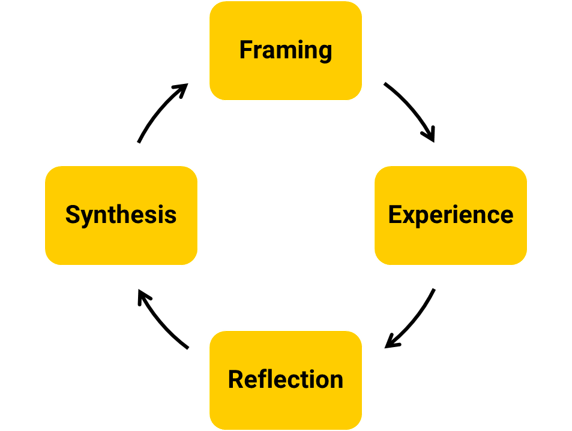
When designing outdoor learning, it is helpful to have a model for structuring the activity, so we’re sharing the instructional cycle as one approach (Roberts, 2016). This model outlines how learners make meaning from experience using an experiential learning perspective.
The Instructional Cycle
Framing
Using the instructional cycle, instructors first establish the context and relevance of the activity, as well as provide guiding questions to support how learners approach the experience.
Experience
Learners engage in the experience through an open-ended activity that allows for exploration, collaboration, and/or immersive involvement.
Reflection
This is followed by reflection, where learners thoughtfully examine what they experienced, and consider their observations, reactions, and emerging patterns. Learners may also reflect on their own learning and how it has changed.
Synthesis
Finally, learners connect their experiences and observations to course concepts, models, ideas, and prior knowledge, to extend the learning beyond the immediate experience.
Stage | Goals | Example Activities |
|---|---|---|
Framing |
|
|
Experience |
|
|
Reflection |
|
|
Synthesis |
|
|
Outdoor teaching and learning spaces on campus
There are several campus spaces you can use for outdoor learning. Living Labs at Iowa is a campus-wide initiative that connects students, faculty, and community partners to use outdoor spaces as authentic environments for teaching, learning, and research.
These spaces engage campus green areas and natural environments as experiential learning settings. A few popular outdoor learning spaces include:

Ashton Prairie
This space includes a prairie ecosystem located on the west campus.

Roots of Medicine Garden
This garden encourages observation and inquiry while exploring the historical and modern uses of medicinal plants, located on west campus.

Lagoon Shelter House
Located along the Iowa River near Hancher, this space combines a historic shelter and green space to support outdoor recreation, informal learning, or group activities.
Learn more about available outdoor campus spaces at the Living Labs at Iowa website.
Teaching in these spaces
Instructors across the University of Iowa are already incorporating outdoor spaces into their teaching! We encourage you to browse case studies created in collaboration between the Living Labs at Iowa team and UI instructors. These case studies highlight engaging outdoor learning activities that these instructors use in their own courses and offer practical guidance for aligning activities with course goals, planning logistics, and facilitating learning in outdoor settings.
Next steps
If you are interested in exploring how outdoor learning fits into your teaching, the Center for Teaching offers one-on-one teaching consultations where we can think with you about your learning goals, activity design, and ways to engage students in outdoor and experiential learning.
You can also explore the Living Labs at Iowa website to learn more about their team and access resources, including descriptions of outdoor learning spaces, maps, practical tools, and ideas for how outdoor teaching fits with your curriculum. Join the Living Labs at Iowa listserv to connect with colleagues across campus who are exploring and practicing teaching outdoors.
References
Association for Experiential Education. (2026). What is experiential education? Retrieved June 4, 2026, from https://www.aee.org/what-is-experiential-education
Gilbertson, K., Ewert, A., Siklander, P., & Bates, T. (2023). Outdoor education: Methods and strategies (2nd ed.). Human Kinetics.
Roberts, J. W. (2016). Experiential education in the college context: What it is, how it works, and why it matters. Routledge.